
 By Cotton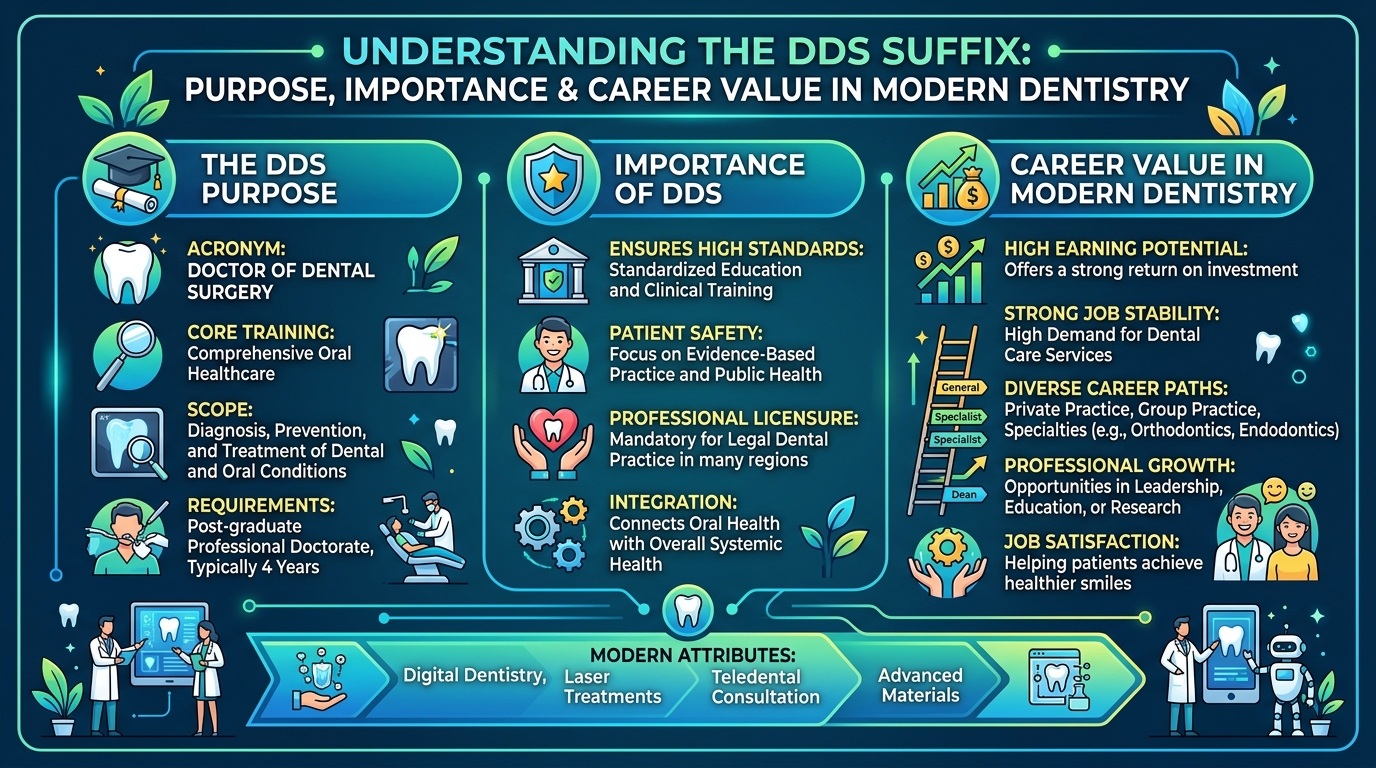
The DDS Suffix is one of the most recognized professional designations in the dental field. Patients often notice these letters after a dentist’s name but may not fully understand what they represent. In professional healthcare environments, educational titles and credentials carry significant meaning because they indicate training, expertise, and qualification standards. The DDS Suffix reflects years of advanced education, clinical practice, and professional responsibility within dentistry.
As oral healthcare continues evolving, professional credentials remain essential for building trust and credibility. Dentists use titles not only to demonstrate academic achievement but also to assure patients that they meet strict medical and ethical standards. Understanding the DDS Suffix provides valuable insight into the dental profession and the qualifications required to become a licensed dental practitioner.
Understanding the DDS Suffix and what the DDS Suffix means
The DDS Suffix stands for “Doctor of Dental Surgery.” It is a professional degree awarded to individuals who complete dental school and meet all necessary academic and licensing requirements.
Despite the surgical wording in the title, the DDS Suffix applies broadly to general dentistry rather than surgery alone. Dentists with this designation are trained to diagnose, prevent, and treat oral health conditions, including cavities, gum disease, and dental injuries.
The degree reflects comprehensive education in oral anatomy, patient care, dental procedures, and clinical practice. Dentists with a DDS credential are fully qualified to provide a wide range of dental services.
The DDS Suffix is commonly used in the United States and several other countries as a standard professional designation for dentists.
History and origin of the DDS Suffix in dentistry
The history of the DDS Suffix dates back to the development of modern dental education. As dentistry evolved into a professional healthcare discipline, educational institutions began establishing formal training programs and degree structures.
The first dental schools introduced standardized curricula to ensure dentists possessed both scientific knowledge and practical skills. The DDS degree became one of the earliest official qualifications in the profession.
Historically, dentistry was often practiced informally without structured education. Over time, healthcare standards increased, leading to licensing systems and academic requirements.
The DDS Suffix helped distinguish formally trained professionals from unlicensed practitioners. This distinction improved patient trust and elevated dentistry into a respected medical field.
As dental science advanced, the DDS credential remained a symbol of expertise and professional responsibility.
DDS Suffix and the educational journey to becoming a dentist
Earning the DDS Suffix requires extensive education and training. The process typically begins with undergraduate study, where students complete prerequisite courses in biology, chemistry, physics, and related sciences.
After completing undergraduate education, aspiring dentists must gain admission to dental school, which is highly competitive. Dental programs generally take four years to complete and combine classroom instruction with clinical training.
During this period, students study oral anatomy, pathology, radiology, pharmacology, and restorative dentistry. Clinical practice allows students to treat patients under professional supervision while developing practical skills.
The final stages often involve licensing examinations that assess both theoretical knowledge and clinical competence. Only after meeting all educational and licensing requirements can an individual officially use the DDS Suffix.
This rigorous process ensures dentists are prepared to provide safe and effective oral healthcare.
DDS Suffix compared to DMD credentials
One common question involves the difference between the DDS Suffix and the DMD designation. DMD stands for “Doctor of Medicine in Dentistry” or “Doctor of Dental Medicine.”
Although the titles sound different, there is no major difference in education, training, or professional authority between DDS and DMD dentists. Both degrees qualify individuals to practice dentistry and require the same level of academic and clinical preparation.
The distinction mainly comes from historical naming preferences among dental schools. Some institutions award DDS degrees, while others grant DMD degrees.
Patients can feel equally confident receiving care from either professional designation because licensing standards remain consistent.
Understanding this equivalence helps reduce confusion and emphasizes that both credentials represent fully qualified dental professionals.
Importance of the DDS Suffix in professional credibility
Professional titles play a significant role in healthcare credibility, and the DDS Suffix is no exception. Patients often rely on credentials to determine whether a healthcare provider is qualified and trustworthy.
The DDS title signals that a dentist has completed accredited education and passed licensing requirements. This reassurance is especially important in healthcare fields where patient safety and expertise are critical.
Professional credentials also support communication within medical communities. Other healthcare providers recognize the DDS designation as evidence of specialized dental training.
In competitive healthcare markets, professional titles help dentists establish authority and reputation. The DDS Suiffix contributes to public confidence and professional recognition.
Maintaining this credibility also requires ongoing education because dental practices and technologies continue evolving.
DDS Suffix and specialization in dentistry
Dentists with the DDS Suffix may choose to pursue specialized fields within dentistry after completing their general degree. These advanced specialties require additional years of training and residency programs.
Orthodontics focuses on correcting alignment and bite issues using braces and other devices. Oral surgery involves surgical procedures affecting the mouth, jaw, and facial structures.
Pediatric dentistry specializes in oral healthcare for children, while periodontics focuses on gum health and dental implants.
Endodontics involves treatments such as root canal therapy, and prosthodontics focuses on restorative solutions like crowns and dentures.
Even after specialization, dentists typically continue using the DDS Suiffix alongside additional credentials or certifications.
Specialization allows dental professionals to focus on specific areas of patient care while expanding career opportunities.
The role of the DDS Suffix in patient trust
Trust is essential in healthcare, and the DDS Suffix helps establish confidence between dentists and patients. Many individuals experience anxiety about dental procedures, making professional reassurance especially important.
Seeing recognized credentials can help patients feel more comfortable and secure during treatment. The DDS title represents expertise, accountability, and adherence to professional standards.
Trust also depends on communication and ethical care. Dentists must explain procedures clearly, prioritize patient safety, and maintain professional integrity.
The DDS Suiffix alone does not guarantee positive patient experiences, but it reflects the foundational qualifications necessary for competent care.
Patients increasingly research healthcare providers online, making credentials and professional transparency even more important in modern dentistry.
DDS Suffix and technological advancement in dentistry
Modern dentistry has changed significantly due to technological innovation, and professionals with the DDS Suffix must adapt continuously to these advancements.
Digital imaging, laser dentistry, 3D printing, and artificial intelligence are transforming how dental procedures are performed. Dentists now use advanced tools to improve diagnosis accuracy and treatment efficiency.
Continuing education helps DDS professionals stay informed about new technologies and treatment methods. Lifelong learning is essential for maintaining professional standards in an evolving healthcare environment.
Technology also improves patient experiences by reducing discomfort, shortening recovery times, and increasing treatment precision.
Dentists who combine clinical expertise with modern innovation are better equipped to meet changing patient expectations and healthcare demands.
Career opportunities associated with the DDS Suffix
The DDS Suiffix opens the door to a wide range of professional opportunities. Many dentists work in private practice, where they provide general oral healthcare services to communities.
Others choose careers in hospitals, academic institutions, research organizations, or public health systems. Some dentists also participate in global healthcare initiatives and humanitarian programs.
Teaching and mentorship are additional career paths. Experienced DDS professionals often train future generations of dentists in universities and clinical programs.
Entrepreneurship is another possibility. Many dentists operate independent clinics and build successful healthcare businesses.
The versatility of the DDS credential makes dentistry a stable and respected profession with long-term career potential.
Challenges faced by professionals with the DDS Suffix
Despite the rewards of dentistry, professionals with the DDS Suiffix also face significant challenges. Dental education is demanding, both academically and financially.
Practicing dentistry requires precision, patience, and strong communication skills. Dentists often work in physically demanding positions while managing patient anxiety and complex procedures.
Healthcare regulations and technological changes also create ongoing pressures to adapt and maintain compliance.
Running a dental practice adds business responsibilities such as staffing, scheduling, insurance management, and financial planning.
Balancing clinical excellence with operational efficiency can be challenging, but many professionals find the career deeply rewarding because of its impact on patient health and confidence.
Final thoughts
The DDS Suiffix represents far more than a professional title. It reflects years of rigorous education, clinical training, ethical responsibility, and dedication to oral healthcare.
From general dentistry to specialized treatment fields, professionals with the DDS credential play a critical role in improving health and quality of life. Their work extends beyond treating teeth to supporting confidence, comfort, and overall well-being.
Understanding the DDS Suiffix helps patients appreciate the expertise behind modern dental care and the commitment required to earn such credentials.
As dentistry continues evolving through technology and innovation, the DDS designation will remain an important symbol of professional excellence and trusted healthcare service.